
HERZ-Foundation
A new impetus for responsibility
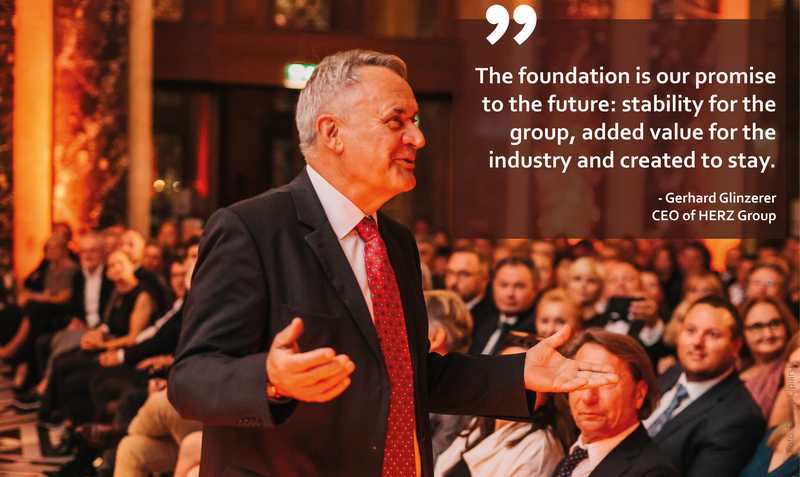
He has transformed a crisis-ridden business into an international group of companies – with vision, perseverance and a clear goal in mind. Gerhard Glinzerer is now setting another groundbreaking example: by establishing the non-profit HERZ-Foundation, he is not only ensuring the company's continued existence, but also creating sustainable added value for the entire industry. In an exclusive interview, the CEO of the HERZ Group talks about responsibility, the future and what really matters.
HERZ News: You are transferring an internationally successful company with numerous subsidiaries, which you have owned for 36 years, to a non-profit foundation. Why?
Gerhard Glinzerer: To answer that question, I need to take a step back and look at the past. In 1989, the year I took over HERZ, the company was an internationally irrelevant valve manufacturer with modest economic success. Production took place at an outdated site in Vienna, supplemented by an assembly plant in Styria and a small sales company in Germany. The owners at the time had decided to sell the company.
HERZ News: You took over a company at a young age that was on the brink of bankruptcy at the time—have you always been willing to take risks?
Gerhard Glinzerer: People may be more willing to take risks when they are young, especially if they have little to lose. Incidentally, under today's circumstances, such a transaction would be completely out of the question, as the shares in the company were the only security for the lending bank and, in the event of a negative economic development, this would probably have led to a loan default.
HERZ News: What was the market reaction to the company at the time? Were there other interested parties?
Gerhard Glinzerer: As it turned out later, competitors had indeed been interested in HERZ, but did not want to spend any money on the ailing Austrian fittings manufacturer and the statement “We don't need to provide HERZ with life support, the problem will resolve itself” was circulated. They would probably have been right, but they had not reckoned with Soviet leader Gorbachev.
HERZ News: What influence did Gorbachev have on HERZ?
Gerhard Glinzerer: The dissolution of the Soviet Empire and freedom for the Eastern European satellite states enabled rapid growth, especially in Eastern Europe, Russia and Central Asia. Over the years, a conglomerate of companies with more than 3,000 employees, numerous production facilities and sales companies with global activities emerged.
HERZ News: So the fall of the Iron Curtain led HERZ to expand?
Gerhard Glinzerer: HERZ has consistently pursued a path of growth since 1989. Growth was normal and expansion was necessary for economic reasons, as were international activities. Of course, the company did not go on a wild buying spree, but rather focused on building up a product range. The starting point was valve production in Vienna, followed by heat pumps and biomass systems and finally the takeover of Hirsch Servo with its insulation products and associated mechanical engineering in Glanegg.
HERZ News: What opportunities do you see for the broadly positioned HERZ Group in the foundation?
Gerhard Glinzerer: Realizing opportunities is essentially the task of the operating companies in the HERZ Group. The foundation provides the stability and security that the companies need for their activities. The decision to establish a non-profit foundation was based on the intention to keep the three areas mentioned above as a single entity and thus ensure mutual support. Above all, colleagues can concentrate on their tasks and avoid the usual games that are common in large corporations.
HERZ News: The foundation model therefore helps to secure the cohesion of all societies for the future. Is the foundation also a step on your part to position HERZ as a reliable and stable partner for all stakeholders in the long term?
Gerhard Glinzerer: Well, after decades of entrepreneurial activity, the question arose as to how the HERZ Group should proceed. There was no successor within the family, and selling the company in whole or in part would of course have been possible. There was also interest from China, but apart from the fact that you can't eat money, this option did not seem adequate to me. Numerous employees had contributed to the success of the company, and I felt connected to them. I wanted to avoid the usual “head-chopping” that follows company takeovers, so the idea of a non-profit foundation came into play and was implemented.
HERZ News: What role do you play within the HERZ Foundation?
Gerhard Glinzerer: The HERZ-Foundation has a board of directors consisting of four people. I am the chairman of the board. The foundation holds shares in HERZ Industries GmbH, the holding company of the group, but is not involved in operational activities.
HERZ News: So everything stays the same, or will the foundation give you a little more breathing space?
Gerhard Glinzerer: I don't expect new freedom in the form of leisure time right away, but there is hope. True to the motto: Dum spiro, spero – As long as I breathe, I hope. (laughs)
HERZ News: Does this mean that there will be no noticeable changes for customers, partners, and employees as a result of the foundation?
Gerhard Glinzerer: As the foundation is the sole owner of the HERZ Group and does not engage in any operational activities, there will be no relevant changes for employees, customers, or suppliers. The most important thing is clarity regarding the future of the company. The shares in the group have been transferred to the foundation, thereby removing any basis for speculation regarding the sale or breakup of the group.
HERZ News: The HERZ Foundation is a non-profit organization. What specific social goals does it pursue?
Gerhard Glinzerer: Income received by the foundation must be used in accordance with its statutes. Central to the foundation's tasks is the promotion of young talent in the field of building technology, i.e., the support of vocational schools, technical colleges, universities of applied sciences and much more. The reasoning behind this is clear: profits from the activities of the group of companies are reinvested in the industry, in apprentices, school pupils, students and all those who work in our industry, are undergoing training, or wish to further their education. There are also plans to launch competitions and give young talent the opportunity to measure themselves against their peers.
HERZ News: What was the biggest challenge in transferring the HERZ Group to a non-profit foundation?
Gerhard Glinzerer: Setting up a non-profit foundation involves a lot of bureaucratic hurdles. Three different authorities were involved and played a key role in making the process of establishing the foundation a multi-year endeavor. (laughs)
HERZ News: Did you ever have any reservations about taking this step?
Gerhard Glinzerer: We spent a considerable amount of time discussing with the auditor and lawyers the extent to which a foundation could achieve the result I wanted. We have come to a positive decision and I am convinced that this solution is the best possible one for a group of this size. Apart from that, I am still working for the company and welcome anyone who is willing to take on a leading position in the company and does not see a four-day week and working from home as a mantra. (laughs)
HERZ News: Looking back on your journey as owner and managing director, would you do anything differently or leave everything the same?
Gerhard Glinzerer: Looking back, numerous mistakes were made, of course, but as the saying goes: only those who do nothing make no mistakes. Ultimately, most of the decisions were right, and with a lot of hard work, dedication, and luck, we all succeeded in building a respectable and successful industrial group.
HERZ News: Thank you for the open discussion and the clear insights into the development of the HERZ Group. By converting the company into a non-profit foundation, you have not only secured its future, but also sent an important signal of stability and reliability—to customers, partners, employees, and the entire industry. In doing so, you have created a solid foundation that inspires confidence and strengthens our shared commitment to the future of the industry.
Non-profit foundations
Non-profit foundations are established for the long-term. Their purpose therefore remains unchanged for generations, creating a stable basis for sustainable support for society. The assets of a non-profit foundation remain untouched.
Non-profit foundations are not profit-oriented. The income generated by a non-profit foundation is permanently invested in projects that benefit society. They pursue exclusively purposes that serve the common good – for example in the areas of education, research, the environment, culture, or social welfare.
An excerpt from the statutes of the HERZ-Foundation...
§ 4 foundation objectives
1. The foundation pursues exclusively and directly charitable and benevolent purposes within the meaning of the Federal Tax Code (BAO); it is not profit-oriented.
2. The foundation promotes education and training in all areas of building technology, particularly in the HVAC industry (heating, air conditioning, ventilation, sanitation) and in the field of building materials production.
3. In accordance with § 37 BAO, the foundation promotes the welfare of people (natural persons) in need who are working in the field of building technology, particularly in the HVAC industry, and in the field of building materials production, especially those who are in need due to illness.
4. Finally, the foundation promotes the general public in accordance with § 35 BAO, with a particular focus on the following areas:
- Vocational training, especially training and further education in all areas of building technology, particularly in the HVAC industry (heating, air conditioning, ventilation, sanitation) and in the field of building materials production.
- Combating damage caused by
- natural forces
- Art and culture
- Sports
- Science and research
Photo: © PhilippLipiarski
© 2026. HERZ