
Biomass-Multitasking
One BINDER boiler for 19 production processes
Wollsdorf Leder has been an integral part of the Austrian leather industry for over 90 years and now has an international presence with locations in Europe, Asia, the USA and South America. But anyone who thinks that a traditional company rests on its laurels does not know Wollsdorf Leder. For generations, the company has been constantly rethinking its approach in order to respond to changing markets, technical requirements and global challenges. The latest step: a 5-megawatt steam boiler from BINDER, which plays an important role in the generation of steam, hot water, warm water, cooling and even electricity.
Wollsdorf Leder
As early as 1936, great-grandfather Alexander Schmidt laid the foundation for leather production, specialising in the manufacture of shoe leather at the time. The great ‘tanner's decline’ in the 1960s led to a switch to furniture leather, and the current factory in Wollsdorf, Styria, was built in 1976. However, the crisis of the 1990s also caused the furniture market to collapse. Instead of giving up, the Schmidt family relied on their skills and in-depth expertise in leather processing and found their way into what is still their core business today: technical leather for the automotive, interior and aircraft industries. Michael Schmidt, General Manager at Wollsdorf Leder, spent many years pioneering biomass technology in South America before returning to the family business. In an interview with HERZ News, he talks about his latest project: efficient process development at Wollsdorf with the help of a BINDER boiler.
HERZ News: Mr. Schmidt, you have had an impressive international career – from Canada to South America, from ship propulsion systems to power plants. How did you get into biomass?
Michael Schmidt: I worked on large energy and propulsion systems for many years. I have always been fascinated by biomass technology. In South America, I saw the potential to make entire industries more sustainable. We had already established efficient biomass solutions in Chile and Uruguay at that time. That had a lasting impact on me.
HERZ News: What was the decisive reason for installing such a comprehensive biomass plant in Wollsdorf?
Michael Schmidt: From raw hide to finished leather, there are a total of 19 processes involved in leather processing. This means we have a wide range of energy requirements: steam, hot water, cold water and electricity. Our goal was to generate as much of this as possible using biomass. A boiler is an investment, so you should get the most out of it.
HERZ News: How is all this made possible by a boiler system?
Michael Schmidt: We opted for a 26 bar BINDER system, although theoretically we could manage with 7 bar. This allows us to use the system to generate electricity, which we need at certain points in the production process. So we divert 7 bar of steam to the consumers that run on steam and the rest goes to the power generation plant via a steam expander.
HERZ News: For which production steps in leather processing is the BINDER boiler used?
Michael Schmidt: For wet processes, we need water at different temperatures, from 25 °C to 60 °C. The BINDER boiler heats the service water, which we obtain from the Raab at 12 °C, to the respective temperatures. For drying, we use steam and, in some cases, electricity as a supplement. The leather is first pre-dried mechanically and then vacuum-dried. However, two-thirds of the drying process is thermal: hot water and cold from the absorption-chiller play a central role here in removing moisture from the drying air and bringing it back to the correct temperature.
HERZ News: Generating cooling from biomass is not common practice, is it?
Michael Schmidt: Cooling from biomass is a rarity, but a great thing if you know how it works. Our absorption-chiller uses residual heat and converts it into cooling. The entire plant is thermally controlled: we produce as much heat as our processes require, and this thermal operation generates cooling and even some electricity as a by-product. For every megawatt hour of steam we produce, we generate around 60 to 80 kilowatt hours of electrical power. This allows us to really get the most out of the BINDER boiler.
HERZ News: Does the BINDER system run continuously at full capacity as a result?
Michael Schmidt: The system is in operation 24 hours a day, 7 days a week. Thanks to its excellent modulation, the BINDER boiler continuously adapts to actual demand and has significantly lower energy consumption. In principle, we consume less energy in kilowatt hours than before with the gas boiler, but that was also the intention. The 26 bar pressure gives us slightly superheated steam, which ensures ideal conditions throughout the entire network – no more steamblows, even in the most remote pipes.
HERZ News: In your opinion, what are the biggest challenges of a biomass plant?
Michael Schmidt: The effort involved in operating a biomass plant is, of course, greater than that of a gas boiler. You need more personnel, more space and so on. I believe that is also the reason why many industries are reluctant to switch to biomass. At the end of the day, however, it definitely pays off – both economically and ecologically. The economic costs alone are half those of operating a gas boiler.
HERZ News: Apart from economic efficiency, what advantages does the plant offer you in practice?
Michael Schmidt: Independence is also a big factor. We are less vulnerable to supply chain problems and have options: we can burn round timber or wood chips. That gives us a freedom we would never have with gas. If there is no gas, then everything comes to a standstill or you have to run the plant on oil, which costs a fortune.
HERZ News: What role did subsidies play in the implementation of this project?
Michael Schmidt: We already wanted to switch to biomass for economic reasons, and then the subsidies came along, which was ideal for us. To qualify, we have to prove that we are saving 5,000 tonnes of CO2 per year. We have already achieved this goal, as we have completely switched off the gas.
HERZ News: So your business has been running completely without gas since September. How does this step feel?
Michael Schmidt: Good, very good indeed. Many companies buy a biomass boiler but only use it during the heating season. The system then often stands idle for eight months, which makes the investment expensive. We use the boiler all year round. The reserve boilers remain on oil as a backup, but our goal was clear: to switch off the gas completely, and we have succeeded in doing so.
HERZ News: You process leather for the automotive industry, among others. How do you see the future of the industry in these difficult times?
Michael Schmidt: These are tough times – inflation, constantly changing conditions, geopolitical uncertainties – but one thing is clear: those who remain flexible, embrace innovation and are prepared to build new solutions from challenges will survive. That has always been the case – and it is still the case today.
HERZ News: Mr. Schmidt, thank you very much for talking to us – and for showing us how much can be achieved with a single biomass plant. Your approach is not only impressive, but also a real example of what innovative process management can look like in practice.

Did you know that...
... leather processing already played an important role in everyday life in the Stone Age?
Archaeological finds of tools show that animal skins have been used for clothing and shelter since the Palaeolithic period (2.5 million to 10,000 BC). In order to protect animal skins from rotting, humans developed simple tanning techniques as early as the Stone Age: First, meat and fat residues were removed with sharp flint scrapers, then the skins were dried in the sun or over smoke. Over time, other treatment methods were added: salts, boiled animal substances such as brains or liver, and fats made the skins increasingly durable, softer and even water-repellent.
Learn more about Wollsdorf Leder Schmidt & Co Ges.m.b.H.
Learn more about BINDER Energietechnik solutions
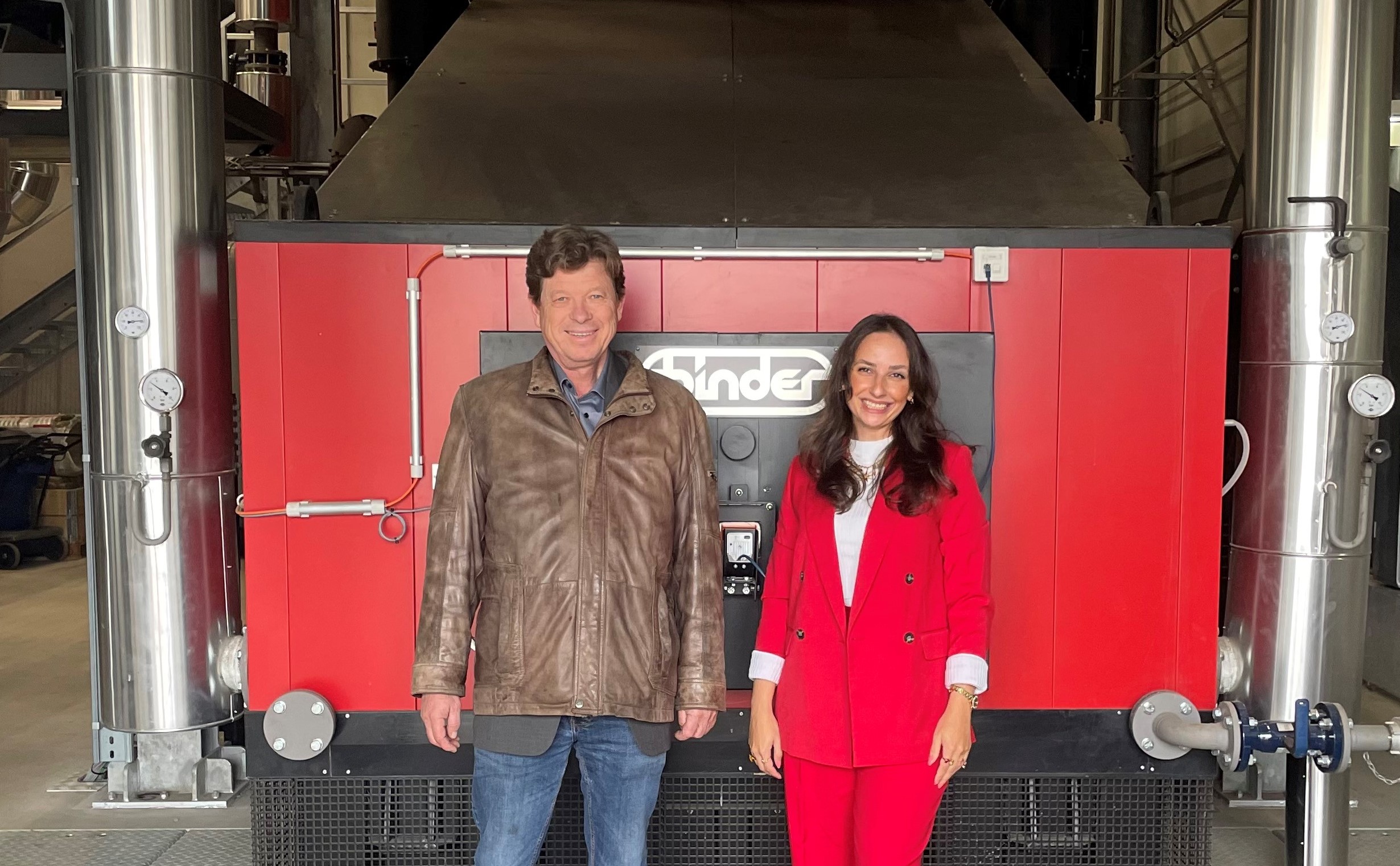
Picture: Michael Schmidt and HERZ News in front of the multi-talented BINDER boiler in Wollsdorf.
© 2026. HERZ