Bad Gleichenberger Naturwärme GmbH
Binder warm water boiler in use
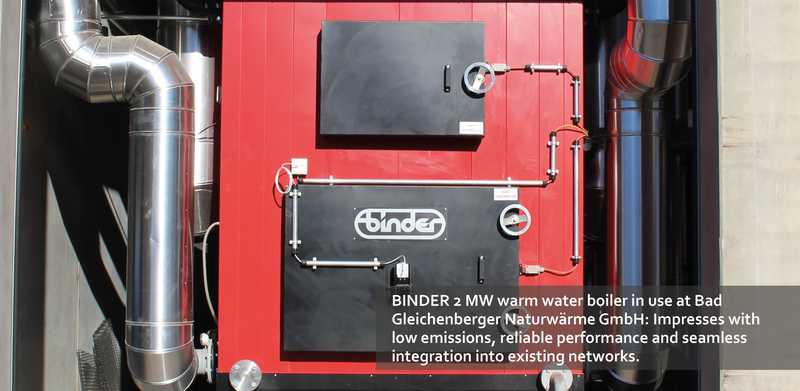
Bad Gleichenberger Naturwärme GmbH is now one of the established regional heat suppliers in south-east Styria. Since its foundation in 2012, the district heating network has been continuously expanded and now supplies more than 60 customers – including large facilities such as the thermal spa, the hospital, several educational institutions, various public buildings and the parish church with its monastery. With the latest expansion and commissioning of a 2 MW BINDER warm water system this year, the company is responding to increasing performance requirements and the growing need for a reliable, regional and CO₂-neutral heat supply.
Bad Gleichenberger Naturwärme GmbH
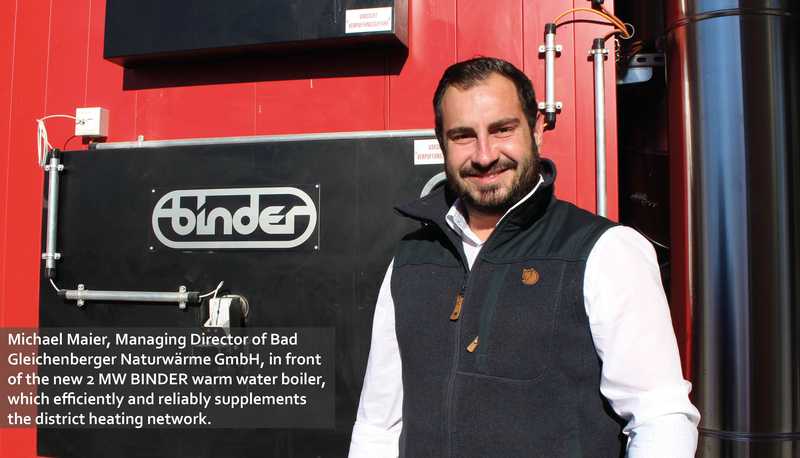
Michael Maier has been managing Bad Gleichenberger Naturwärme GmbH together with Ulrich Kiendler since 2024. For Michael Maier, the company is more than just a business – he grew up with it and took over its management in 2024. For him, Naturwärme is a long-term regional project that requires responsibility, commitment and vision. In an interview with HERZ News, he provides insights into the daily challenges of a district heating operator.
HERZ News: Bad Gleichenberger Naturwärme GmbH has been in existence since 2012. How has the facility developed since then?
Michael Maier: We started with a small network and 13 customers. Today, we have more than 60 customers and our pipeline network covers around 14 kilometres. It was particularly exciting to observe how interest has changed. When the discussion about gas supply gained momentum, many people came to us in search of crisis-proof alternatives. The growth was not abrupt, but increased slightly each year and was therefore very stable.
HERZ News: What were the fundamental considerations at the outset of the entire project?
Michael Maier: It was always crucial for us that the model was economically viable and at the same time strengthened regional value creation. We wanted a solution that was competitive with fossil fuels and at the same time secured jobs in the region. Equally important was CO₂-neutral heat supply, because this enables us to create a sustainable offering that will remain relevant in the long term.
HERZ News: The funding situation has often been unpredictable in recent years. How much has this affected you?
Michael Maier: The suspension of subsidies had little impact on our expansion, as we had enough interested parties. In the private sector, however, the impact was severe. Programmes such as ‘Get out of oil and gas’ motivated many households to switch to district heating. When the subsidies were suspended, everything came to a standstill. This was a setback for the entire sector because demand suddenly slowed down.
HERZ News: At the beginning of this year, you installed a third boiler system and opted for a BINDER warm water boiler. What were the decisive factors?
Michael Maier: The decision was based on technical and economic considerations. We had to integrate parts of the new plant into an existing building, which imposed clear spatial constraints on the conveyor technology and wood chip feed. An additional boiler house was built adjacent to the existing warehouse. With BINDER, we were able to adapt the plant so that we could neatly accommodate a powerful 2 MW solution despite structural limitations. We were also impressed by the emission and immission characteristics, which are relevant for further grid expansion.
HERZ News: What does the business look like today?
Michael Maier: Due to our customers' performance requirements, thermal energy is provided all year round. The boilers operate in a modulated manner depending on the load requirements, with the BINDER system optimally supplementing the existing network and ensuring that we can provide reliable and efficient heat at all times.
All three systems use regionally sourced biogenic raw materials to generate warm water and heating exclusively. Fail-safety is particularly important to us. Since all three boilers never run at the same time, we can react immediately in the event of malfunctions and always have a reserve in the background. This ensures the continuous, reliable operation of the district heating network – for large and small customers alike.
HERZ News: What challenges do you face in your day-to-day work as a district heating operator?
Michael Maier: The biggest unknowns are raw material and electricity prices. This affects the entire industry. We source all of our wood chips from the region, which makes supply more stable, but price fluctuations remain an issue. Last year, we needed around 20,000 cubic metres – depending, of course, on the length and severity of the heating period. In addition, we have to respond immediately in the event of a malfunction, because a district heating network does not tolerate delays. 24/7 availability is therefore mandatory.
HERZ News: Looking ahead: What developments do you expect to see in the coming years?
Michael Maier: Network consolidation and expansion remain an issue, but always in line with actual customer interest. Should further large customers be added, we could replace the 1 MW boiler to provide additional capacity. In any case, the foundation has been laid and with the BINDER system, we have taken an important step towards remaining stable and competitive in the future.
HERZ News: Thank you very much for your authentic insights into the work and decisions of a district heating operator. Your experiences impressively demonstrate the challenges, considerations and strategies behind a reliable, regional heating network.
Learn more about our BINDER Energietechnik solutions.
© 2026. HERZ